

In This Page
Is Kutu (ROSCA) Permissible in Islam?
Quick summary: The Islamic ruling on main kutu depends on how the contract is structured, not on the basic concept itself. Kutu is essentially a form of ta'awun (mutual help), a group of people contribute periodically and take turns receiving the full pooled amount. As long as there's no riba (interest), no gharar (ambiguity) in the turn order and amounts, and every member consents freely, many scholars permit it. The real problem with kutu isn't the ruling, it's the risk of the organizer running off with the money, since it isn't backed by any real asset and has no legal guarantee.
What Is Kutu
Main kutu (also known as kutu duit or ROSCA, rotating savings and credit association) is an arrangement where a group of people agree to contribute a fixed amount periodically, usually monthly, and each round one member receives the full pooled amount in turn, until every member has had their turn. This is a long-standing practice in Malaysian society, usually among co-workers, neighbours, or family members, built on mutual trust.
The Islamic Ruling: Why Many Scholars Permit It
Structurally, kutu most closely resembles qard (a loan) carried out repeatedly on a collective basis, each member essentially lends to the other members in turn, and receives back the same amount with no additional charge. Because there's no riba (interest on a loan) involved in the original structure of kutu, and it's based on ta'awun (mutual help), most views permit it as long as:
The contribution amount is fixed and agreed upon by everyone from the start
The turn order is decided fairly, by draw, fixed rotation, or unanimous agreement
No interest or additional charge is imposed on anyone
Every member understands and consents to the terms from the outset, with no gharar over when and how much they'll receive
Because the ruling depends on the actual contract structure used, not just the name "kutu," it's more accurate to refer directly to your state Mufti's Office or the Federal Territory Mufti's Department for a ruling based on the specific kutu arrangement you're joining, especially if there's any element of additional payment, late charges, or any form of "profit" beyond the original contribution amount.
When It Becomes Problematic
Kutu can turn into a Shariah issue when the original structure is altered, for example, the organizer imposes a hidden "management fee," there's an interest-like late payment charge, or turns are bought/sold with a markup (this can fall under riba). If any of these elements exist, it's no longer pure kutu in the sense of ta'awun, it has become an interest-bearing loan structure disguised under the name kutu.
The Real Risk: The Organizer Running Off With the Money
This is the part that's rarely discussed but matters more to most people than the ruling alone: kutu isn't backed by any real asset, has no regulator, and has no formal legal guarantee. Everything depends entirely on trust in the organizer. If the organizer (or any member in an early turn) runs off with the pooled money before the other members get their turn, the members who haven't received their turn yet lose all their contributions with no easy way to get it back.
This isn't a hypothetical scenario, "kutu lari" (runaway kutu) cases are frequently reported in Malaysia, usually involving small groups of co-workers or local community members who didn't think they needed any written documentation because "everyone knows everyone." Unfortunately, trust alone isn't protection.
If you've ever worried "what if the organizer runs off", that's a sign you've already spotted the real problem. Not the ruling, but the safety structure. Want to know how structured gold savings avoids this risk? Ask us directly.
A Safer Alternative: Structured Physical Gold
If your purpose for joining kutu is the discipline of saving periodically, not specifically wanting an early payout, there's another way to achieve the same goal without depending entirely on trust in one organizer. Structured physical gold savings, for example, gives you the same periodic contribution discipline, but every ringgit you put in immediately becomes real physical gold in your own name, not cash held by someone else until your turn comes.
The basic difference: in kutu, you carry risk against the organizer and other members for the whole period before your turn. In transparent structured gold savings, you hold a real asset from day one, not a promise of a future turn.
Frequently Asked Questions
Is main kutu haram in Islam?
Not necessarily. The basic structure of kutu, fixed contributions, fair rotation, no interest, aligns with the permitted concepts of ta'awun and qard. It becomes an issue when riba or gharar is added into the original structure.
What's the difference between kutu and riba?
Riba involves an additional charge on a loan. Pure kutu has no additional charge, every member receives back the exact amount they contributed via other people, just at a different time. It becomes riba if there's an added charge, late-payment interest, or turns being bought and sold with a markup.
Why do many people still worry about kutu even though the ruling permits it?
Because the real risk isn't about the ruling, it's about financial safety. There's no regulator, no formal legal guarantee, and it depends entirely on trust in the organizer and other members.
How do I make sure the kutu I'm joining is safe from a Shariah standpoint?
Make sure there's no additional charge of any kind, turns are decided fairly and transparently, every member understands the terms from the start, and ideally check with your state Mufti's Office for a ruling based on your group's specific arrangement.
At AurumLX, We Build Structures That Don't Rely Solely on Trust
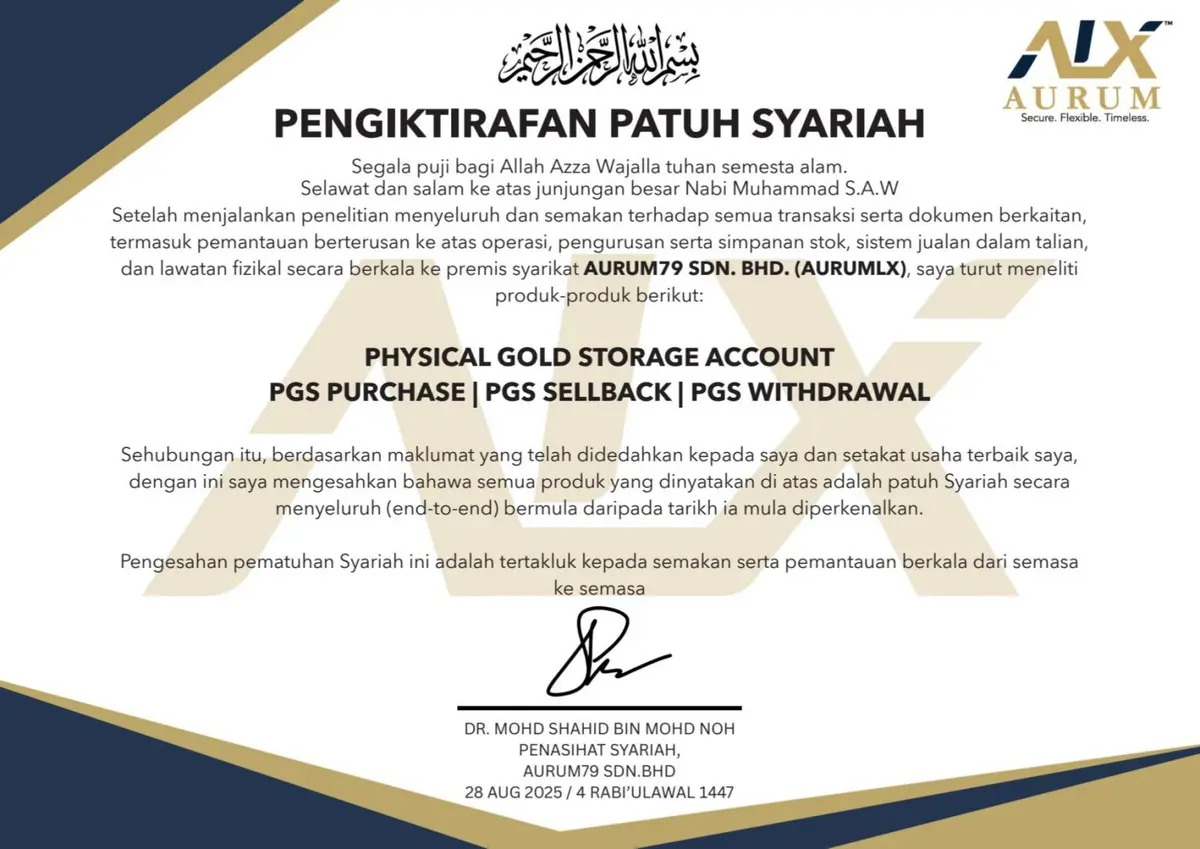
AurumLX is operated by Aurum79 Sdn. Bhd., a company registered in Malaysia, with official Shariah compliance recognition for our physical gold operations, covering purchase, buyback, and withdrawal, subject to ongoing Shariah monitoring. Every ringgit you put in becomes real physical gold in your name, not a wait for your turn or dependence on one organizer. Read more about the Shariah-compliant gold principles we hold to.
Also read: gold scams in Malaysia and how to avoid them, or other types of investment scams to watch out for.